How a clear market gap took Desktronic across Europe
Written by Emma Viström, October 2025
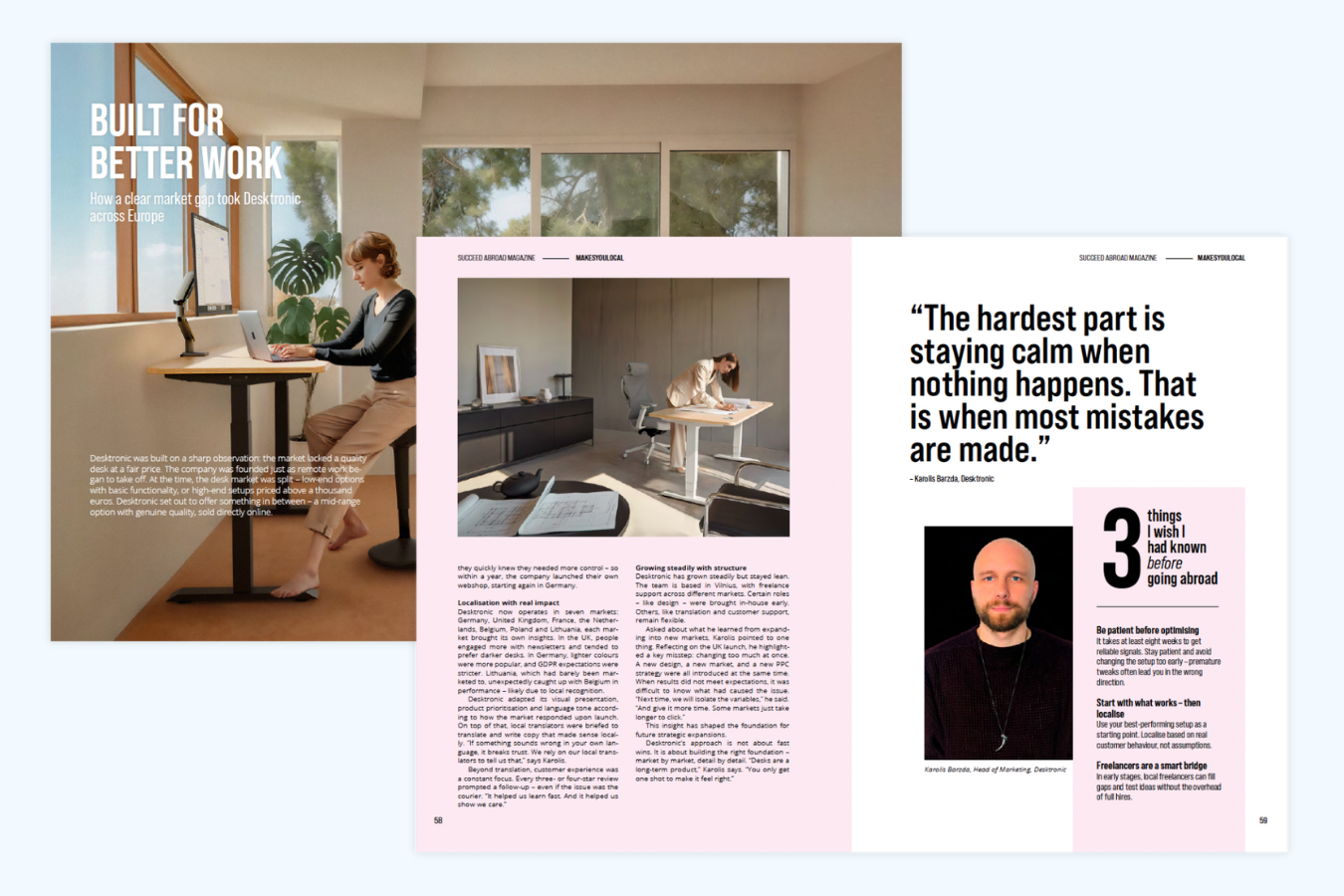
Desktronic was built on a sharp observation: the market lacked a quality desk at a fair price. The company was founded just as remote work began to take off. At the time, the desk market was split – low-end options with basic functionality, or high-end setups priced above a thousand euros. Desktronic set out to offer something in between – a mid-range option with genuine quality, sold directly online.
That decision has taken the company from a small warehouse in Lithuania to customers across seven European markets. We spoke to Karolis, part of the team behind Desktronic’s expansion. He joined shortly after their early traction on Amazon and helped shape the brand’s international growth – from market selection and localisation to performance marketing and customer experience.
Focused range for simpler decisions
From the beginning, Desktronic launched with a very limited product selection: just one desk model, available in different sizes and finishes. That simplicity was intentional.
“We saw competitors listing five or six models with barely noticeable differences,” says Karolis.
“For customers, that’s overwhelming. We wanted to remove friction, not add it.” Quickly, a “pro” version of the desk was added to the selection, however, the focus was still on a lean product assortment.
That clarity also helped with logistics and support. Each variation – colour, width – was listed separately on Google Shopping, giving the brand broad visibility without complexity.
Germany was their first market. Rather than start at home, Desktronic launched on Amazon to test demand where the volume was highest. The early results were encouraging – but their very first shipment nearly sank the business. The desks arrived in mid-winter, and none of them worked.
The electric lifting columns had frozen during transport. Karolis recalls how the founder spent two nights manually resetting each one. That experience set the tone: hands-on, fast to respond, and focused on solving problems.
Amazon gave Desktronic reach and cash flow. But they quickly knew they needed more control – so within a year, the company launched their own webshop, starting again in Germany.
Localisation with real impact
Desktronic now operates in seven markets: Germany, United Kingdom, France, the Netherlands, Belgium, Poland and Lithuania, each market brought its own insights. In the UK, people engaged more with newsletters and tended to prefer darker desks. In Germany, lighter colours were more popular, and GDPR expectations were stricter. Lithuania, which had barely been marketed to, unexpectedly caught up with Belgium in performance – likely due to local recognition.
Desktronic adapted its visual presentation, product prioritisation and language tone according to how the market responded upon launch. On top of that, local translators were briefed to translate and write copy that made sense locally.
“If something sounds wrong in your own language, it breaks trust. We rely on our local translators to tell us that,” says Karolis.
Beyond translation, customer experience was a constant focus. Every three- or four-star review prompted a follow-up – even if the issue was the courier. “It helped us learn fast. And it helped us show we care."
Growing steadily with structure
Desktronic has grown steadily but stayed lean. The team is based in Vilnius, with freelance support across different markets. Certain roles – like design – were brought in-house early. Others, like translation and customer support, remain flexible.
Asked about what he learned from expanding into new markets, Karolis pointed to one thing. Reflecting on the UK launch, he highlighted a key misstep: changing too much at once. A new design, a new market, and a new PPC strategy were all introduced at the same time. When results did not meet expectations, it was difficult to know what had caused the issue.
“Next time, we will isolate the variables,” he said. “And give it more time. Some markets just take longer to click.”
This insight has shaped the foundation for future strategic expansions.
Desktronic’s approach is not about fast wins. It is about building the right foundation – market by market, detail by detail. “Desks are a long-term product,” Karolis says. “You only get one shot to make it feel right.”
Three things I wish I had known before launching
Each brand featured in Succeed Abroad – The Magazine shared three lessons they wish they had known before expanding abroad. Here are the three that stood out most to Karolis:
- Be patient before optimising
It takes at least eight weeks to get reliable signals. Stay patient and avoid changing the setup too early – premature tweaks often lead you in the wrong direction. - Start with what works – then localise
Use your best-performing setup as a starting point. Localise based on real customer behaviour, not assumptions. - Freelancers are a smart bridge
In early stages, local freelancers can fill gaps and test ideas without the overhead of full hires.
Read more brand stories from Succeed Abroad – The Magazine here.