Why a custom LLM is the smartest translation investment a growing e-commerce brand can make
Written by Signe Bergström, June 2026
Most e-commerce brands expanding into new markets think about translation too late - and too narrowly. They treat it as a one-off task: get the products translated, go live, move on. But if you are running a webshop with a catalogue that changes regularly, that approach does not grow with you. And it tends to get expensive fast.
There is a better model. And it gets sharper the more you use it.
What is a custom LLM - and why does it matter for translation?
A LLM is a model trained on large amounts of text. LLM stands for "Large Language Model", and it can generate, translate and adapt language and big amounts of text at scale.
Many of the standard LLMs, like ChatGPT, are trained on general content from the internet. It knows the language. But it does not know your brand.
A custom LLM is different.
A custom LLM is trained specifically on your content, your product descriptions, your tone of voice, your category pages, and your terminology. Over time, it learns how you write. It knows that you want to use the term "Children" instead of “Kids", or replace words to fit into being gender neutral, or listing product names to run on very specific rules.
The result is translation output that is accurate, consistent and very "on-brand" - across every market.
How BabySam translated 2,000 products in four days
What happens when you add 200 new products to your webshop? Or when you need to update your category pages across five markets? Or when a merger means you need 2,000 product descriptions translated in four days?
BabySam had days, not weeks. And traditional agencies could not meet the timeline.
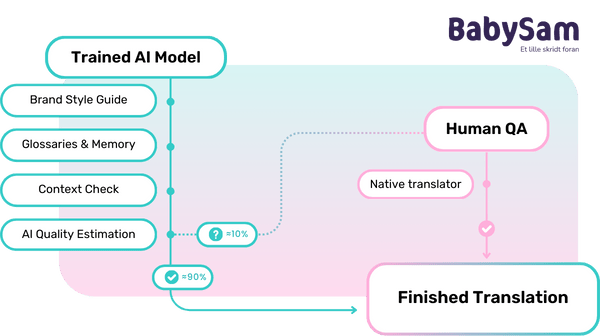
Using a custom LLM trained on BabySam's product terminology and brand guidelines, with native specialist review on top, MakesYouLocal delivered 2,037 accurate, market-ready product translations in four days.
As Alina Oleshchenko, Head of Business Development and PMI at BabySam, put it:"Rapid translation was crucial during the agile period of the companies' merger, serving as a key support and time saver. It allowed us to swiftly introduce products to the Swedish market while maintaining our tone of voice."
The numbers tell the story clearly:
-
40% cheaper than traditional translation
-
10 times faster deliver
-
98% accuracy rate
-
0 missed deadlines
The model gets better over time
This is where a custom LLM becomes a genuine long-term asset rather than just a faster translation service.
Every time you submit new content, the model learns. Your terminology becomes more consistent. Your brand voice becomes more precise. The more you use it, the less time native specialists need to spend correcting or adjusting output - which means costs go down and turnaround times get shorter.
For BabySam, this means that future product launches and additions can now be localised within one to two days.
Where native specialists still matter
A custom LLM handles volume. But it should not replace human judgement entirely - and it should not.
The most effective setup combines AI for scale with native specialist review for the content that drives trust and conversion: category pages, checkout flows, key product descriptions and campaign copy.
These are the moments where a customer decides whether to buy - and where the difference between accurate translation and truly localised content becomes commercially relevant.
75% of consumers prefer to buy in their own language. But only if it sounds natural. A technically correct translation that reads like a translation will still lose customers.
Native specialists understand how customers in each market decide to buy. They know which product benefits carry most weight in Germany versus France, how urgency language lands differently in Scandinavia, and whether a tone that works in Denmark will feel too direct in the Netherlands.
The custom LLM handles the volume. The native specialist shapes the experience.
Who this setup makes sense for
A custom LLM is not the right solution for every business. If you are doing a one-time launch into a single new market, a standard translation service may be perfectly sufficient.
But if you are:
-
Running a catalogue that changes regularly
-
Operating across multiple markets simultaneously
-
Adding new products, campaigns or content on an ongoing basis
-
Planning further market expansion in the next 12 to 24 months
— then building a custom model is almost certainly the more cost-effective and scalable choice in the long run.
The setup takes one to two weeks to train. After that, it works for you — continuously, consistently and at a pace that keeps up with how international e-commerce businesses actually operate.
The practical takeaway
Translation is not a one-off cost. For a growing e-commerce business, it is an ongoing operational need - and the brands that treat it that way are the ones that manage to sound like themselves in every market they enter.
A custom LLM built on your content, reviewed by native specialists who understand your markets, is the setup that makes that possible at scale.